AI Agents as Consultants: How to Staff, Bill, and Measure When Your Team Includes Machines
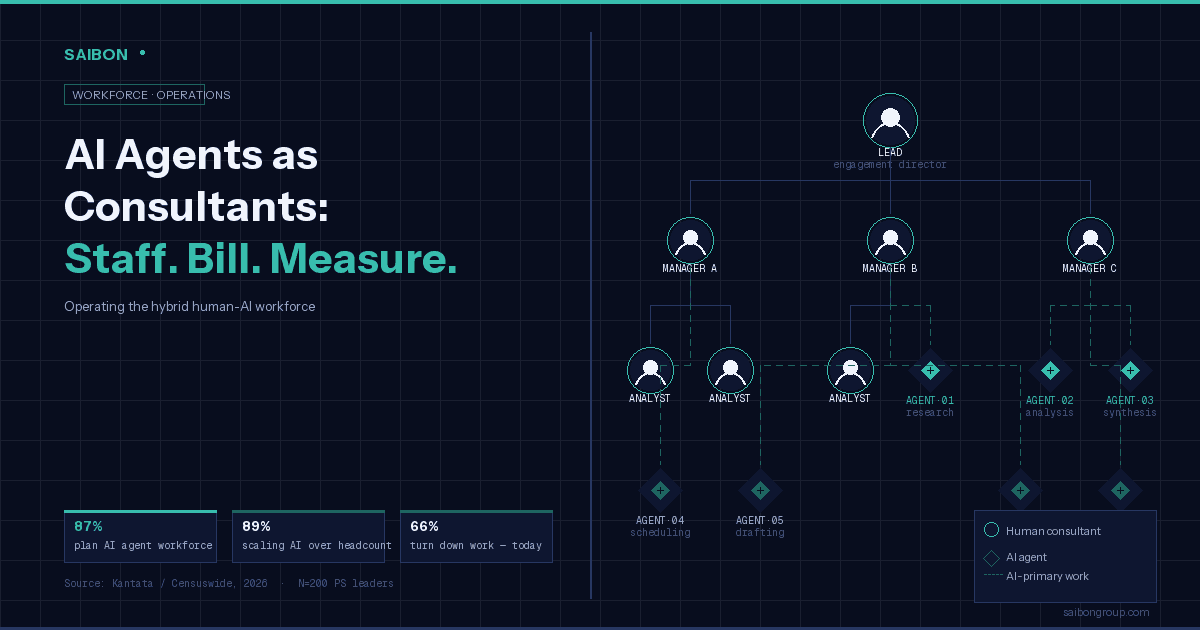
McKinsey now has 20,000 AI agents working alongside its 40,000 human consultants. A year and a half ago, that number was 3,000. The shift happened faster than most consulting firm leaders anticipated, and it raises three operational questions that nobody prepared an answer for: How do you staff a team that includes machines? How do you bill clients when AI does part of the work? And how do you measure utilization when your workforce is half human, half algorithm?
Key Takeaways
87% of professional services firms plan to manage AI agents as part of their workforce (Kantata, 2026)
89% of PS leaders say future revenue growth depends more on scaling AI than scaling headcount
The three operational challenges are staffing ratios, billing model redesign, and utilization measurement
Firms that define the human-AI boundary before deployment achieve significantly higher adoption rates
Traditional utilization formulas break down in hybrid teams and need to be rebuilt from first principles
The Shift Is Already Happening, Whether You Have a Plan or Not
The question for consulting firm leaders is no longer whether AI agents will become part of their workforce. According to a January 2026 survey of 200 professional services leaders by Kantata and Censuswide, 87% of firms plan to manage AI agents as part of their workforce. Nearly as many (89%) say future revenue growth will depend more on how effectively they scale AI than on how they scale headcount.
What makes this inflection point different from previous waves of automation is the nature of what AI agents actually do. Earlier tools automated tasks: document formatting, data entry, scheduling. AI agents complete work: drafting deliverables, synthesizing research, generating first-pass analysis, managing client communications. The line between "tool" and "team member" has shifted, and the operational structures most consulting firms have in place were built for a team of humans.
The firms that get ahead of this will not necessarily be the ones that adopt AI fastest. They will be the ones that build the right operational infrastructure around it.
Part 1: Staffing – Redefining Roles and Setting the Human-AI Boundary
The first operational challenge is knowing who does what. In a team that includes AI agents, every role needs a defined scope, and so does every agent. Leaving this ambiguous is expensive.
Define the boundary before you deploy
Research from Deloitte's 2025 AI deployment analysis found that firms defining the human-AI boundary before deployment achieved 73% user adoption, compared to just 31% when boundaries were ambiguous. The boundary question is simple to state and hard to answer: for each deliverable, what does the AI produce, and what does the human professional validate, enrich, or override?
A practical starting point is to categorize your work by deliverable type:
AI-primary, human-reviewed: First drafts, data analysis, document summarization, market research synthesis. The AI does the work; a consultant checks quality and adds judgment.
Human-primary, AI-assisted: Client strategy sessions, stakeholder management, complex problem framing. The consultant leads; AI handles prep and follow-up.
Human-only: Anything requiring trust, accountability, or relationship capital that cannot be delegated. Signing off on recommendations, managing difficult conversations, ethical judgment calls.
Adjust your staffing ratios
Once the boundary is defined, you can revisit staffing ratios. If AI agents handle the analytical load that previously required two junior analysts, the question becomes: what is the right ratio of senior to junior staff in an AI-augmented engagement?
McKinsey CEO Bob Sternfels noted in early 2026 that client-facing roles at the firm are growing by 25%, while non-client-facing roles are shrinking. That pattern is consistent with what happens when AI takes on internal analytical work: you need more people who can convert that analysis into client value, and fewer people whose primary job was producing the analysis in the first place.
For most mid-market consulting firms, this means a gradual shift toward leaner engagement teams with higher consultant-to-AI-agent ratios, compensated by stronger quality review at the senior level. The risk of getting the ratio wrong in either direction is real: too lean and quality suffers; too many humans and the economics of AI-augmented delivery never materialize.
Create new operational roles
Firms in the vanguard are also creating new internal roles that did not exist two years ago. Kantata's 2026 survey found that 73% of professional services firms plan to hire "integrity layer leads," 47% plan to hire "workflow engineers," and 42% plan to hire "agent orchestrators." These are not AI specialists in the traditional sense. They are operational roles focused on making human-AI collaboration reliable and auditable.
Part 2: Billing – Three Models for AI-Augmented Delivery
The billing question is where most consulting firm leaders get stuck. If an AI agent completes in two hours work that previously took a junior consultant two days, what do you charge?
The honest answer is that there is no single right model. The right model depends on your client relationships, your margin structure, and how much AI is embedded in your delivery. But there are three frameworks worth understanding.
Model 1: Outcome-based billing
Charge for the result, not the time. If your firm delivers a market entry analysis that enables a client decision worth millions, the value of that analysis does not change because AI helped produce it faster. Outcome-based billing protects your margins as AI reduces your cost-to-deliver.
This model works best when you have established client relationships, clear deliverable definitions, and measurable success criteria. It requires more upfront scoping but produces better economics over time.
Model 2: Tiered capacity pricing
Rather than billing by the hour, bill by the level of capacity you are committing. A firm might offer three tiers: a foundational engagement (AI-primary delivery, light senior oversight), a standard engagement (balanced human-AI team), and a premium engagement (senior-led with AI acceleration).
This model is easier to sell to clients who are skeptical of outcome-based arrangements and still want to understand what they are paying for.
Model 3: Hybrid hourly with transparency
Some clients, particularly those in regulated industries, will insist on hourly billing. In these cases, the emerging practice is to bill AI-agent hours at a lower rate than human hours, with transparent documentation of which deliverables were AI-primary. This maintains the client's sense of control while allowing the firm to capture some margin benefit from AI efficiency.
The risk with this model is margin compression over time as clients benchmark AI rates and push them down. Firms that rely on it exclusively will find it increasingly difficult to sustain revenue per engagement as AI speeds up delivery.
Regardless of which model you choose, the consistent advice from firms navigating this transition is to address the billing question explicitly with clients early. Clients who discover mid-engagement that AI produced work they assumed was human-produced tend to react badly, even if the quality is good.
Part 3: Measurement – Utilization in a Hybrid Workforce
Traditional consultant utilization formulas measure one thing: billable hours as a percentage of available hours. That formula breaks down in a hybrid team, because AI agents do not have fixed available hours, do not go on bench, and do not accrue the same costs as human staff.
Ninety percent of professional services leaders told Kantata that their systems will need to attribute work, costs, and value across both humans and AI agents in the near future. Most current systems cannot do this.
Rethink what you are measuring
For human consultants in a hybrid team, the utilization question shifts from "are they billable?" to "are they adding the judgment, relationship, and oversight value that justifies their cost?" A senior consultant spending 60% of their time on billable work that is mostly reviewing AI output is being used very differently from one spending the same 60% on client-facing strategy.
The more useful metrics in a hybrid workforce are:
Revenue per consultant (humans only): tracks whether reducing AI-intensive admin work is translating into more senior-level billing
Deliverable throughput: how many engagements or deliverables is the team completing per consultant per quarter
AI-to-human cost ratio per project: what percentage of a project's internal cost is human vs. AI, and how does that track against margin targets
Quality review rate: how often does human review result in material changes to AI output, and is that rate declining as the team calibrates its prompts and processes
Track AI agent output separately
AI agents should be tracked as a capacity layer, not as headcount. The relevant questions are: what categories of work are agents completing, at what volume, and at what error rate? This is operational data, not utilization data, and it needs to live somewhere your resource managers can actually see it.
Sixty-six percent of professional services firms currently turn down work because of resourcing constraints. AI agents represent a direct lever on that number, but only if you can see in real time what capacity they have and where they are deployed. Firms that treat AI capacity as invisible infrastructure will keep turning down work they could take on.
What This Means for Consultant Matching
The emergence of AI agents as workforce members does not reduce the importance of human consultant matching. It raises the stakes. When every engagement involves a combination of human consultants and AI agents, the quality of the human component matters more, not less, because humans are now responsible for the judgment, quality oversight, and client relationships that AI cannot handle.
Getting the right human consultant into the right role, faster than your competitors can, remains one of the most reliable levers on utilization and deal win rates. The difference is that in 2026, the firms doing this well are not doing it with spreadsheets. They are using AI-powered matching tools that can surface the right consultant based on skills, availability, and client fit in seconds rather than days.
The firms that will win the next five years are the ones that treat both their human consultants and their AI agents as managed resources, with clear roles, measurable output, and operational infrastructure that makes them visible. That requires a different kind of tooling than most consulting firms currently have.
Frequently Asked Questions
What is an AI agent in the context of a consulting firm?
An AI agent is a software system that can complete tasks autonomously, such as drafting deliverables, synthesizing research, or generating analysis, as part of a delivery workflow. Unlike automation tools that handle discrete tasks, AI agents can manage multi-step work and adapt based on inputs. Consulting firms increasingly treat them as a capacity layer that works alongside human consultants.
How should consulting firms bill clients when AI agents do part of the work?
There are three main models: outcome-based billing (charge for the result regardless of who produced it), tiered capacity pricing (bundle human and AI capacity into clearly defined service tiers), and hybrid hourly with transparency (bill AI work at a lower rate than human work, with documentation). Most firms with established client relationships find outcome-based billing produces the best margins over time.
How do you measure consultant utilization when AI agents are part of the team?
Traditional utilization metrics (billable hours / available hours) apply to humans but not AI agents. In hybrid teams, the more useful metrics are revenue per consultant, deliverable throughput per quarter, AI-to-human cost ratio per project, and quality review rates. AI agents should be tracked separately as a capacity layer, not counted in headcount utilization figures.
What staffing changes do consulting firms need to make for AI-augmented delivery?
The key change is defining the human-AI boundary for each deliverable type before deployment. Firms also need to adjust staffing ratios, typically fewer junior analysts and more senior reviewers, and build new operational roles such as workflow engineers and agent orchestrators who ensure human-AI collaboration is reliable and auditable.
Are clients comfortable paying the same rates when AI does more of the work?
Client comfort varies. Clients in established relationships tend to accept outcome-based models where value, not time, is the billing basis. Clients in regulated industries or newer relationships often want transparency about what AI contributed and may push for lower rates on AI-primary deliverables. The firms navigating this best are those that address the conversation proactively rather than waiting for clients to raise it.
Sources
Kantata and Censuswide. "Kantata Survey Reveals that 87% of Professional Services Teams Plan to Manage AI Agents as Part of Their Workforce." BusinessWire, January 2026. https://www.businesswire.com/news/home/20260108295161/en/Kantata-Survey-Reveals-that-87-of-Professional-Services-Teams-Plan-to-Manage-AI-Agents-as-Part-of-Their-Workforce
Sternfels, Bob (McKinsey CEO). Statements on McKinsey AI workforce composition. HR Grapevine / HCA Magazine, January 2026. https://www.hcamag.com/us/specialization/hr-technology/mckinsey-trials-ai-led-job-interviews-as-20000-ai-agents-reshape-its-workforce/562007
McKinsey & Company. Internal AI usage statistics (1.5 million hours saved, Lilli platform adoption). Various press coverage, 2025-2026.
Thomson Reuters. "Future of Professionals Report 2025." Thomson Reuters Institute, 2025. https://insight.thomsonreuters.com.au/legal/resources/resource/future-of-professionals-report-2025-thomson-reuters
Deloitte. "AI deployment analysis: human-AI boundary definition and user adoption rates." 2025. (Referenced via thinking.inc/en/industry-service/professional-services-ai-use-cases/)
Chargebee. "Selling Intelligence: The 2026 Playbook for Pricing AI Agents." 2026. https://www.chargebee.com/blog/pricing-ai-agents-playbook/
Kantata. "Looking Ahead: 7 Trends and Predictions for Professional Services in 2026." 2026. https://www.kantata.com/blog/article/looking-ahead-7-trends-predictions-for-professional-services-in-2026/
Saibon helps consulting firms match the right human consultants to the right projects in seconds, so your senior staff spend their time on judgment and client relationships, not hunting through spreadsheets. Book a demo to see how it works.