Most consulting firm CEOs know bench time is expensive. Almost none know exactly how expensive, because nobody has given them the math to find out.
This article gives you that math. Use the framework below to calculate what bench time is costing your firm today, compare it against industry benchmarks, and understand the full cost, including the hidden costs that don't show up in your P&L.
TL;DR – Key Takeaways
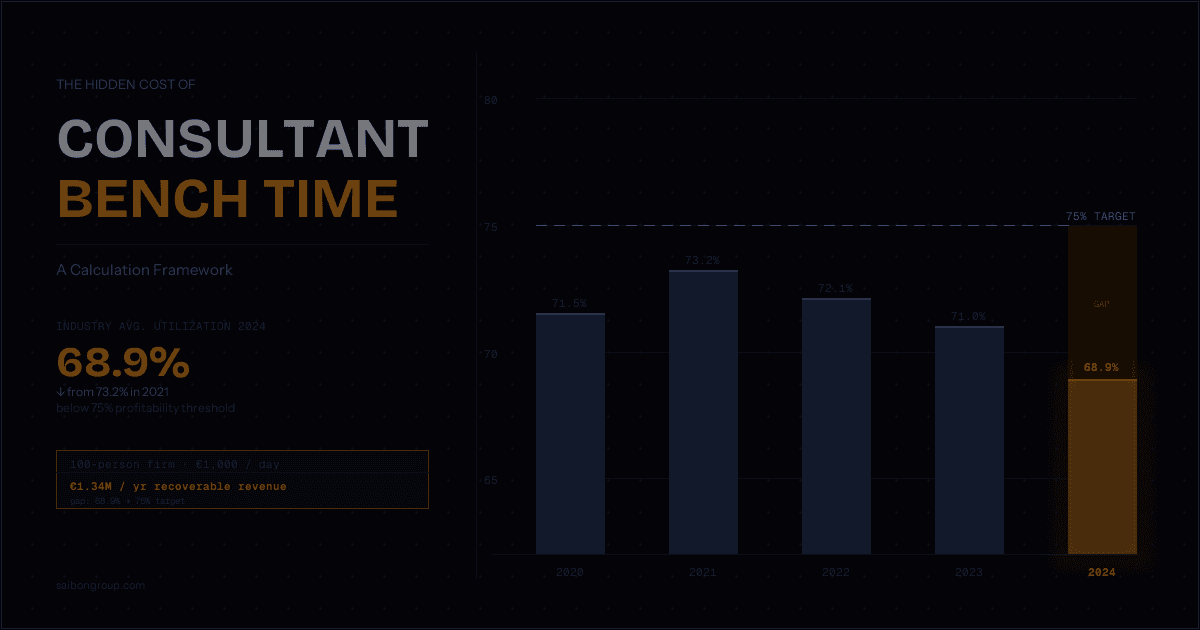
Industry-wide billable utilization fell to 68.9% in 2024, down from 73.2% in 2021, the lowest in five years
Every percentage point of utilization you recover is worth hundreds of thousands of euros annually, depending on your firm size and day rates
Bench time has three cost layers: direct lost revenue, hidden operational costs (turnover, morale), and deal losses from slow staffing
Most firms can't see their bench problem in real time because they're tracking it in spreadsheets with data that's days or weeks old
Raising utilization from 68.9% to 75%, the industry target, is the equivalent of hiring new consultants without paying for them
What Billable Utilization Actually Means (and Why 75% Is the Threshold)
Billable utilization is the percentage of available working days your consultants spend on revenue-generating client work. A consultant who works 220 days per year and bills 154 of them has a utilization rate of 70%.
The industry has long treated 75% as the minimum threshold for healthy profitability. Below that, margin pressure compounds fast, not linearly but exponentially, because fixed costs (salaries, office, admin) don't shrink when utilization drops.
According to the 2025 SPI Research Professional Services Maturity Benchmark Report, the industry average fell to 68.9% in 2024, the fourth consecutive year of decline from a high of 73.2% in 2021. The same report notes that EBITDA across professional services firms dropped from 15.4% in 2023 to just 9.8% in 2024. Revenue per consultant fell from $207,000 to $199,000 in the same period.
These aren't separate trends. They're the same problem measured three ways.
The Bench Time Cost Calculator: Your Numbers
Here is the calculation framework. Run it with your own headcount and day rates.
Step 1: Calculate your available billable days
Step 2: Calculate revenue at your current utilization
Step 3: Calculate your bench time gap
Run it at your firm size
Firm size | Day rate | Gap: 68.9% → 75% | Gap: 68.9% → 80% |
|---|---|---|---|
50 consultants | €800/day | €537K/year | €1,224K/year |
100 consultants | €1,000/day | €1.34M/year | €3.06M/year |
200 consultants | €1,200/day | €3.23M/year | €7.34M/year |
These are not hypothetical. They represent real, recoverable revenue that currently belongs to a line called "bench."
The Three Cost Layers of Bench Time
Most firms only count the first layer. The real cost is the sum of three.
Layer 1: Direct Revenue Loss
This is the calculation above – unbilled days multiplied by your day rate. For the typical 100-person consulting firm in 2024, running at the industry average utilization, this amounts to more than €1.3 million in unrecovered revenue per year.
It is also, paradoxically, the easiest cost to fix, if you have visibility.
Layer 2: Turnover and Morale
Bench time is not neutral for your consultants. Extended periods off client work trigger disengagement, and disengagement drives turnover.
Research cited by Benchbee found that consultants with more than three weeks of consecutive bench time showed 40% higher turnover rates. The cost of replacing a consultant, including recruitment, onboarding, ramp-up time, and lost client relationships, typically runs 50–150% of annual salary.
A firm that loses three senior consultants per year to bench-driven disengagement is adding €200,000–€500,000 in replacement costs on top of the direct revenue loss. This never appears in the bench time calculation.
Layer 3: Lost Deals from Slow Staffing
The third cost is the most invisible: the RFPs you respond to late, the clients you say no to, the projects you lose because you couldn't staff them fast enough.
When a buyer sends an RFP, your competitor is also getting that email. The firm that responds with the right consultant profile, the right skills and the right availability, within 24 hours wins more than the firm still searching its spreadsheets three days later.
For a firm doing €15M in annual revenue, winning even one additional project per quarter that was previously lost to slow staffing represents a 5–10% revenue uplift. This cost is never counted. It's a ghost in your pipeline.
Why Bench Time Is So Hard to See
The fundamental problem is not bench time itself. It's visibility.
Most consulting firms track consultant availability in spreadsheets – sometimes multiple spreadsheets, updated manually, by different people, on different schedules. By the time a resource manager knows a consultant is rolling off a project, they have three to five days to find the next engagement. The search is reactive, manual, and stressful.
According to Projectworks, firms using manual tracking miss emerging gaps because the data is often days or weeks out of date, exactly the window in which proactive placement becomes impossible.
The result: bench time accumulates not because consultants aren't available, but because no one sees them becoming available until it's too late.
What Top-Performing Firms Do Differently
Firms that consistently run at 75–80% utilization share three operational characteristics:
Real-time availability visibility. They know, today and not next week, which consultants are rolling off, when, and what skills they hold. This turns staffing from reactive to proactive.
Proactive matching, not reactive searching. Instead of searching for a consultant when a project lands, they're surfacing available consultants to project leads and account managers before the gap opens.
Shorter time-to-staff on inbound demand. When an RFP arrives or a client asks for a profile, the firm that responds in hours rather than days has a structural advantage. This is not just operational efficiency; it's a revenue multiplier.
These three capabilities compound. A firm with all three running doesn't just reduce bench time. It converts the same headcount into measurably more revenue without hiring.
Frequently Asked Questions
What is a good consultant utilization rate for a consulting firm?
The industry benchmark is 75% billable utilization as a minimum for healthy margins. According to the 2025 SPI Research Benchmark Report, the average across professional services firms fell to 68.9% in 2024, below this threshold. High-performing management consulting and IT services firms typically target 78–82%, while sustaining above 85% risks consultant burnout and turnover.
How do you calculate consultant bench time cost?
Multiply the number of bench days by your average daily billing rate. For a 100-person firm at €1,000/day running at 68.9% utilization, the gap to the 75% industry target represents approximately 1,342 unbilled days per year, or €1.34 million in recoverable revenue. Use the formula: Consultants × Working days × (Target rate − Current rate) × Day rate.
What causes high bench time in consulting firms?
The most common causes are poor visibility into rolling project end dates, reactive (rather than proactive) staffing, slow CV and profile preparation when responding to RFPs, and reliance on manual spreadsheets that give a delayed view of consultant availability.
What is the difference between bench time and non-billable time?
Bench time refers specifically to consultants who are unassigned and available, not generating revenue. Non-billable time is broader: it includes internal meetings, training, business development, and administration. A consultant spending time on sales support is non-billable but not necessarily on the bench.
How does bench time affect consultant turnover?
Extended bench periods, typically three or more consecutive weeks, are associated with significantly higher turnover rates. The replacement cost for a departed consultant typically runs 50–150% of their annual salary, adding a substantial hidden cost on top of the direct revenue loss from unfilled days.
Can software actually reduce consultant bench time?
Yes. Specifically, software that gives real-time availability visibility, automates CV and profile preparation, and proactively surfaces consultants to relevant opportunities. The mechanism is speed: firms that can identify and place an available consultant in hours rather than days recover bench time that would otherwise accumulate by default.
Sources
SPI Research 2025 Professional Services Maturity Benchmark – Service Performance Insight, 2025. https://spiresearch.com/reports/2025-ps-maturity-benchmark/
Benchbee – "5 Ways Your IT Consultancy Is Losing Money on Bench Time" – Benchbee, 2024. https://benchbee.io/blog/5-ways-your-it-consultancy-is-losing-money-on-bench-time/
Projectworks – "How Expensive Are My Unassigned Consultants?" – Projectworks, 2024. https://www.projectworks.com/blog/how-expensive-are-my-unassigned-consultants
The Bottom Line
Bench time is not a staffing problem. It's a visibility and speed problem.
The revenue sitting in your bench is real and recoverable. For most consulting firms with 50–200 consultants, it runs into six or seven figures annually. And that's before counting the turnover costs and the deals you lost while searching spreadsheets.
The calculation is straightforward. The harder question is whether you have the systems to act on it fast enough.
Saibon gives consulting firms real-time visibility into consultant availability, automates CV generation for faster RFP responses, and surfaces available consultants proactively, so bench time becomes a manageable metric rather than a mystery cost.